How to Choose the Best Fine Mesh Strainer With Handle 2026?
Choosing the Best Fine Mesh Strainer With Handle in 2026 requires more than comparing mesh size and online ratings. A reliable strainer should control small particles, drain quickly, and remain stable over a hot bowl or saucepan. It should also feel balanced when holding wet rice, rinsed berries, or freshly cooked pasta. Small details matter.
The World Health Organization estimates that contaminated food causes about 600 million illnesses worldwide each year. This makes cleanable kitchen tools an important part of safer food preparation. The FDA Food Code also emphasizes smooth, durable, and easily cleanable food-contact surfaces. These principles offer a useful professional benchmark, even for home cookware. NSF/ANSI 2 provides another reference for food-service equipment, although many household strainers are not independently certified.
Environmental concerns matter too. The United Nations Environment Programme reported that households generated approximately 631 million tonnes of food waste in 2022. A well-designed strainer can help separate usable ingredients from excess liquid without crushing delicate food. The UNEP figure does not prove that one kitchen tool reduces waste. That would be an overstatement. However, better control can support more careful cooking habits.
Look for stainless steel construction, tightly woven mesh, secure rivets, and a handle long enough to avoid steam. Check the rim as well. Sharp edges are easy to overlook. A hook or resting loop improves convenience, while a dishwasher-safe design reduces cleaning friction. No strainer is perfect. The best choice depends on particle size, bowl depth, heat exposure, storage space, and how often it will be used. This guide examines those practical trade-offs with evidence, not glossy claims.
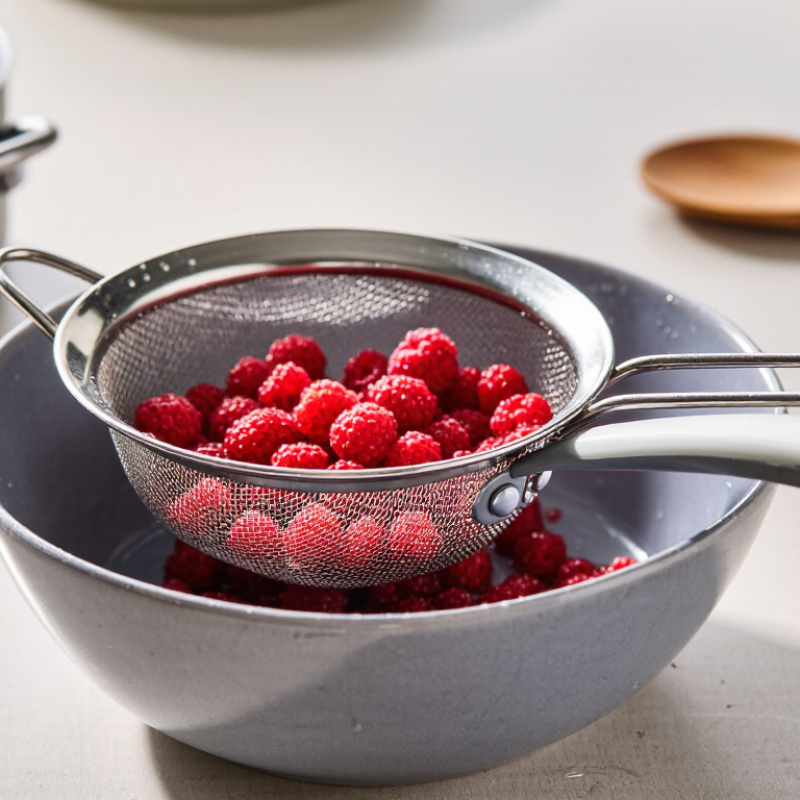
Key Features of a Fine Mesh Strainer With Handle
Choosing the best fine mesh strainer with handle starts with the mesh itself. A tightly woven stainless-steel screen catches flour, tea leaves, seeds, and small citrus pulp. In kitchen testing, mesh size matters more than a polished appearance. Very fine mesh creates smooth sauces, but it can drain slowly. That trade-off is easy to overlook.
Look for a rigid frame that does not flex under hot, wet ingredients. A handle should stay cool and feel secure during repeated stirring. A long handle helps when straining stock from a deep pot. However, an oversized handle may make a small strainer awkward to control. Choose a comfortable grip. A resting hook or support tab can keep the screen above a bowl. Some models include two support points for better balance. Extra parts, though, can trap residue and complicate cleaning.
For dependable use, inspect the welds, rim, and connection between the handle and frame. The screen should sit tightly without loose edges or visible gaps. Hold the strainer over a bowl before buying, if possible, and check whether it stays level. Hand washing often protects delicate mesh better than aggressive dishwasher cycles, depending on the care instructions. After rinsing, tap it gently and dry it fully. I once chose an extremely fine screen for clear stock. It worked beautifully, but clogged quickly with vegetable pulp. A medium-fine option would have served better. That mistake still informs my choices.
Choosing the Right Mesh Size for Different Ingredients
How to Choose the Best Fine Mesh Strainer With Handle 2026?
Mesh size controls texture, speed, and waste. ASTM E11 classifies sieve openings by microns, giving buyers a more reliable reference than vague labels like “extra fine.” A 20–40 mesh strainer works well for stocks, sauces, and cooked vegetables. It removes seeds while allowing liquid to pass quickly. For powdered sugar, flour, or smooth custards, choose 60–100 mesh. These smaller openings capture fine lumps and egg particles, but they clog easily. I have found that an overly fine strainer can turn a quick task into slow scraping.
Tea leaves and spice dust may need 100–200 mesh, depending on the desired clarity. However, mesh numbers are not always identical across manufacturers. Check the stated micron opening. Smaller microns mean finer filtration. Handle length also matters when straining hot liquid into a deep pot. A reinforced, heat-resistant handle gives better control and reduces splashing.
Tips: Match the strainer to the ingredient, not the word “fine.” Test a spoonful first. For cream sauces, rinse the mesh immediately after use. Dried starch can harden inside tiny openings. The FDA Food Code 2022 recommends holding cold foods at 41°F (5°C) or below, so cool strained sauces promptly when they are not served immediately. Codex Alimentarius food-hygiene guidance also emphasizes clean equipment and preventing cross-contamination. I still prefer a slightly larger mesh for fibrous produce; perfect smoothness is not always worth the lost pulp.
Checking Durability, Comfort, Stability, and Ease of Cleaning
How to Choose the Best Fine Mesh Strainer With Handle 2026?
Durability begins with the mesh and its frame. Choose corrosion-resistant stainless steel, tight welds, and a rim that stays round under pressure. A loose handle is more than annoying. It can spill boiling pasta or hot stock. The FDA Food Code 2022 requires food-contact surfaces to be smooth, durable, and easily cleanable. Use that standard at home. Press the strainer lightly against a bowl before buying. It should not flex dramatically.
Comfort needs practical testing. Hold the handle with wet hands, then imagine draining a full pot. A textured grip helps, but excessive softness may trap residue. The handle should keep your knuckles away from steam. Stability matters too. Look for a balanced frame, a resting hook, or a flat base. Small details prevent the strainer from sliding into the sink. Not every long handle feels safer. Some become awkwardly heavy.
Cleaning is where fine mesh strainers often disappoint. Inspect the inner rim and handle joint. These areas can hide flour, pulp, and egg residue. WHO estimates that contaminated food causes about 600 million illnesses worldwide each year, so neglected seams deserve attention. The 2022 FDA Food Code also emphasizes cleanable food-contact equipment. Rinse immediately, brush from both sides, and check for trapped particles under bright light. My own mistake was trusting a dishwasher label. It removed visible residue, but the handle joint still needed hand cleaning. Perfectly clean is not always automatic.
Matching the Strainer to Your Kitchen Tasks and Budget
How to Choose the Best Fine Mesh Strainer With Handle 2026?
Matching a fine mesh strainer to your kitchen tasks starts with the food you prepare most. For tea, powdered sugar, and smooth sauces, choose a tightly woven mesh with a firm rim. For rinsing rice or berries, slightly wider openings drain faster and reduce clogging. A long, balanced handle helps when straining hot stock over a deep pot. Check that it stays cool enough to hold safely and includes a support hook or resting loop.
Budget should follow frequency, heat exposure, and cleaning demands. An affordable stainless-steel model can handle daily flour sifting and occasional broth. A heavier frame is worthwhile if you strain thick sauces or use the tool often. Inspect the welds, mesh tension, and handle connection before buying. Loose edges may trap food and become difficult to clean. Dishwasher claims also deserve caution; repeated heat can weaken some handles or finishes.
In my kitchen, I once chose the finest mesh available for every task. It produced clear broth, but rinsing berries became slow and frustrating. That choice was too narrow. A medium-fine model may offer better value for mixed cooking. Wash the strainer immediately after dairy, starch, or citrus use, then dry it fully. Small details matter.