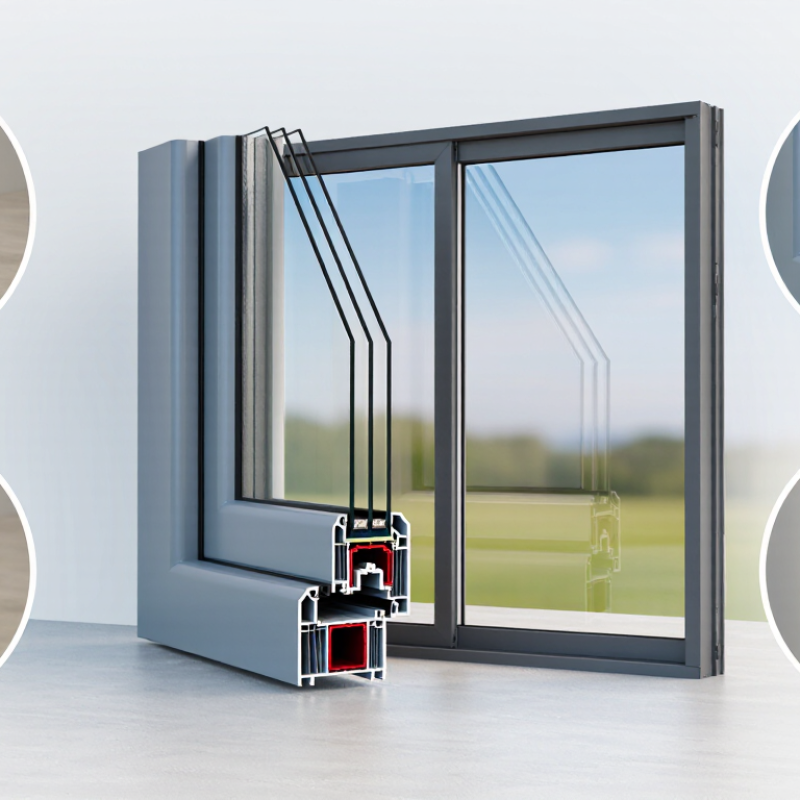
What Are the Best Dual Pane Windows from China? This question deserves more than a factory price or polished product photo. The best dual pane windows should combine verified thermal performance, stable frame construction, dependable seals, and careful quality control. A window may look impressive in a showroom, yet perform poorly after years of sun, wind, and temperature changes.
The U.S. Department of Energy’s Energy Saver guidance estimates that windows can account for 25% to 30% of residential heating and cooling energy use. That figure makes glass selection more important than many buyers expect. Low-emissivity coatings, argon gas, warm-edge spacers, and suitable U-values can reduce heat transfer. NFRC certification also gives buyers a consistent method for comparing U-factor and solar heat gain performance. Still, certification does not guarantee perfect installation. Small gaps around a frame can defeat expensive glazing.
China has a large and technically capable window manufacturing sector. Leading suppliers may offer insulated glass units, thermally broken aluminum frames, uPVC systems, and customized performance testing. However, “best” depends on climate, building orientation, hardware, and local installation skill. Dr. Joseph Lstiburek, a respected building-science expert, has stated, “A building is a system.” That principle applies here. A strong window cannot fully correct poor flashing or incorrect sizing.
This guide will compare Chinese manufacturers through measurable evidence, not assumptions. Some claims may remain difficult to verify. That is worth admitting. Buyers should request current test reports, sample units, warranty terms, and third-party certification before choosing a supplier.
Dual pane windows contain two glass panes separated by a sealed insulating space. The gap usually holds air or argon gas. A spacer keeps the panes apart. Sealant helps prevent moisture from entering.
Heat moves through glass, frames, and edges. The second pane slows this movement. Low-emissivity coating can reflect indoor heat back into a room during cold weather. In summer, it can reduce solar heat entering through the glass. The result is a more stable indoor temperature and less work for heating or cooling systems.
When evaluating dual pane windows from China, I examine the glass specification, spacer design, frame material, and sealing quality. I also check thermal performance values and independent test documents.
Small details matter.
A poorly sealed edge can create fogging between panes. Installation matters just as much. I once focused too heavily on glass thickness and overlooked the frame’s drainage design. That was a useful correction. A strong window can still perform badly when the opening is measured incorrectly or the seal is damaged during transport. Ask for sample sections, test reports, and clear warranty terms before placing a large order. Safety glass may also be necessary near doors, low openings, or crowded indoor areas.
High-quality dual pane windows from China begin with verified glass performance, not appearance. Look for Low-E coatings, sealed insulating units, and a clear U-value report. A lower U-value usually means better insulation. Solar heat gain also matters in warmer regions. The right balance depends on local climate and window orientation.
The spacer should reduce heat transfer around the glass edge. Warm-edge spacers can help limit condensation. Argon-filled cavities may improve insulation when the seal remains intact. Ask for seal durability testing, not only a factory claim. Tempered glass improves impact safety, while laminated glass can reduce noise and hold together after breakage. Good drainage channels are important. Small details matter.
Frame quality deserves equal attention. Reinforced aluminum, uPVC, or fiberglass frames should resist warping and repeated movement. Hardware should feel firm after many opening cycles. Check corner joints, gaskets, locks, and drainage holes before ordering. Factory quality control should include dimensional checks, air leakage tests, water resistance tests, and sample inspections by an independent party. Installation can still weaken excellent glass. Poor shimming or incomplete sealing causes drafts and moisture. I would not trust the lowest quotation without technical drawings, test records, warranty terms, and replacement procedures. Some specifications look impressive but remain difficult to verify. That is where careful review matters.
Chinese dual pane windows can offer strong value, but material choice affects durability, insulation, and maintenance. uPVC frames provide good thermal resistance and suit humid coastal areas when drainage is properly designed. Aluminum frames are slimmer and stronger, yet they need a reliable thermal break to reduce heat transfer. Fiberglass is stable across temperature changes, although it may cost more and have fewer design options.
Glass specifications deserve careful comparison. Low-emissivity coatings can reduce winter heat loss and summer solar gain. Argon-filled cavities improve insulation, but poor seals can reduce performance over time. In noisy locations, laminated inner glass may help soften traffic sounds. Tempered glass improves safety after breakage, but it does not replace proper installation. Spacer quality also matters. Warm-edge spacers can limit condensation around the glass perimeter.
A practical comparison should include U-factor, solar heat gain coefficient, air leakage, and tested wind resistance. Ask for independent test reports, sample corner welds, hardware details, and warranty terms. On inspection, small gaps near the frame often reveal more than attractive brochures. Details matter more. No option wins every climate. My initial preference may favor aluminum for large openings, but a well-made uPVC window can perform better in a poorly insulated building. Factory quality varies, so written specifications and third-party verification remain essential.
When evaluating dual pane windows from China, begin with documents, not attractive product photos. Ask for certification records tied to the exact frame, glass, spacer, and hardware combination. Reports for another model may not represent the window you will receive.
For North American projects, check NFRC-certified U-factor and solar heat gain coefficient values. Also review air leakage, water penetration, and structural pressure results under relevant AAMA or FGIA procedures. ASTM E283, E331, and E330 reports can provide useful test evidence. For European projects, confirm applicable CE documentation and declared thermal performance. Chinese suppliers may also provide results based on GB/T 11944, GB/T 8484, and GB/T 7106. These standards can help, but buyers should confirm acceptance with local authorities.
Look for laboratory reports issued by facilities accredited to ISO/IEC 17025. Check the report date, sample size, glass thickness, gas type, and test temperature. Argon-filled units should include measured gas concentration, not only a sales claim. Low-emissivity glass needs a coating specification and visible quality inspection. Ask about condensation resistance too. It matters in cold bedrooms and humid kitchens.
Do not treat a certificate as a guarantee. Installation errors can destroy good test results. I would request production samples, edge-seal details, and packaging photographs before placing a large order. Some documents look complete but omit hardware or spacer information. That gap deserves questions. A careful buyer should also compare warranty terms, replacement procedures, and batch traceability.
| Buyer Check | Relevant Standard or Certification | Recommended Specification or Benchmark | Evidence to Request from the Supplier | Why It Matters |
|---|---|---|---|---|
| Insulating glass unit durability | ASTM E2190 or EN 1279 | Certified insulating glass unit performance, including resistance to fogging, moisture penetration, and seal failure | Complete test report identifying the glass configuration, spacer, sealant system, test laboratory, and report date | Confirms that the dual-pane unit is designed to retain insulating performance and resist internal condensation over time. |
| Chinese insulating-glass compliance | GB/T 11944 | Compliance with the applicable Chinese standard for insulating glass | Test report showing the exact product construction, nominal glass thickness, cavity width, spacer type, and sealant details | Provides a product-specific reference for manufacturing quality and insulating-glass durability in the Chinese market. |
| Thermal transmittance | NFRC 100, ISO 10077-1/2, or GB/T 8484 | Window U-factor approximately 1.1–1.6 W/m²·K for a well-designed low-emissivity dual-pane window; lower values indicate better insulation | Certified whole-window U-factor, not only center-of-glass data; request the frame, spacer, glass, and opening-size details used for calculation | Whole-window performance includes the frame and edge area, which can perform differently from the glass center. |
| Low-emissivity coating | Product specification and laboratory verification | Low-E coating on the correct surface, with the specified emissivity and solar-control characteristics | Glass make-up drawing, coating position, emissivity value, optical data, and coating inspection records | Low-E glass reduces radiant heat transfer, but incorrect coating placement or an unsuitable coating can reduce energy performance. |
| Solar heat gain | NFRC 200 or ISO 9050 | SHGC commonly around 0.25–0.40 for solar-control applications; the suitable value depends on climate, orientation, and shading | Certified Solar Heat Gain Coefficient and visible-transmittance values for the complete window assembly | Lower SHGC can reduce summer cooling loads, while higher SHGC may be useful where passive winter solar gain is desired. |
| Visible light transmission | NFRC 200 or ISO 9050 | Typically about 0.45–0.70 for many clear or low-E dual-pane configurations, subject to coating and tint selection | Visible Transmittance value and the exact glass combination used for testing | Helps buyers balance daylight, glare control, privacy, and solar performance. |
| Air leakage | NFRC 400, ASTM E283, or EN 1026 | For many North American specifications, air leakage no greater than 0.3 cfm/ft² at 1.57 psf is a strong target | Air-leakage test report stating the test pressure, direction, product size, and leakage result | Lower air leakage improves comfort and reduces uncontrolled heat loss, drafts, dust, and outdoor-noise paths. |
| Water penetration resistance | ASTM E331, AAMA 501.1, EN 1027, or GB/T 7106 | The tested pressure should meet or exceed the project design requirement; no uncontrolled water penetration should occur during testing | Water-resistance report with test pressure, duration, product size, drainage design, and installation condition | Performance depends on the window, drainage paths, joints, and installation—not only on the glass unit. |
| Wind-load and structural resistance | ASTM E330/E330M, EN 12211, or GB/T 7106 | Design pressure should be calculated for the building location, height, exposure, window size, and local wind conditions | Structural calculation and test report showing positive and negative pressure, deflection, permanent deformation, and product dimensions | Prevents excessive frame movement, glass stress, hardware failure, and seal deterioration in windy conditions. |
| Frame and sash material | Applicable material and product standards; supplier quality-control documentation | Thermally broken aluminum, uPVC, or another frame system with documented profiles, reinforcement, and compatible hardware | Profile cross-section drawings, alloy or material information, thermal-break details, reinforcement specification, and production inspection records | The frame and thermal bridge design strongly affect whole-window U-factor, air tightness, strength, and service life. |
| Gas filling and cavity width | Factory process control; ASTM E2649 or equivalent gas-content verification where applicable | Argon-filled cavities are common; cavity width is usually selected within the glass system’s tested design range, often approximately 12–16 mm for many dual-pane units | Gas type, nominal fill percentage, cavity width, gas-retention method, and random production verification records | Gas fill can improve insulation, but actual performance depends on cavity geometry, seal quality, spacer design, and retention over time. |
| Spacer and warm-edge design | System specification; thermal modeling under NFRC or ISO methods | Warm-edge spacer with low thermal conductivity and a continuous, compatible seal system | Spacer material, conductivity data, corner-joint design, sealant compatibility information, and whole-window thermal model | Warm-edge spacers reduce edge heat loss and interior-edge condensation compared with highly conductive metal spacers. |
| Safety glazing | ANSI Z97.1, CPSC 16 CFR 1201, EN 12600, or applicable local code | Tempered or laminated safety glass where required by location, impact risk, door application, or building code | Safety-glazing certification, glass marking information, and location-specific compliance statement | Safety glazing reduces injury risk from accidental human impact and may be mandatory in doors or hazardous locations. |
| Acoustic performance | ASTM E90/E413 or ISO 10140/717-1 | Request a tested STC or Rw value for the exact window assembly; laminated glass and asymmetric panes may improve sound insulation | Laboratory sound-transmission report with glass thicknesses, airspace, frame type, seals, and complete window dimensions | Sound performance cannot be reliably estimated from glass thickness alone; the frame, seals, and installation are also important. |
| Condensation resistance | NFRC 500 | Higher Condensation Resistance Index is preferable; compare products using the same size, climate conditions, and frame assumptions | NFRC 500 result or equivalent condensation analysis for the complete window assembly | Condensation resistance helps assess interior-surface temperature, edge effects, spacer quality, and frame thermal bridging. |
| Environmental and chemical compliance | REACH, RoHS, and applicable destination-market requirements | Written compliance for restricted substances, coatings, sealants, plastics, hardware, and packaging components | Declaration of conformity, material declarations, safety data sheets, and third-party testing where required | Reduces regulatory, customs, workplace, and project-approval risks in the importing country. |
| Factory quality management | ISO 9001 is useful but does not replace product-performance testing | Documented inspection plan covering glass, profiles, corner joints, seals, hardware, dimensions, and final operation | Current quality certificate, inspection and test plan, sample records, nonconformance procedure, and traceability method | A management-system certificate supports process control, but product-specific test evidence remains essential. |
| Product certification for the destination market | NFRC certification, CE marking where applicable, or local building-code approval | Certification and labeling that match the final product configuration, intended market, and installation category | Certificate number, scope of certification, product listing, label sample, and confirmation that the certificate covers the exported model | Certificates are only useful when they apply to the exact system being purchased, including frame, glass, spacer, and hardware. |

Selecting Chinese dual pane windows requires more than comparing prices. Begin with your project’s climate, orientation, and noise conditions. A coastal building needs strong corrosion resistance. A cold-region home needs a lower U-factor. Review U-factor, SHGC, visible transmittance, and air-leakage ratings. Request complete test reports, not cropped screenshots. Small details matter.
Examine the glass specification carefully. Many projects use 5 mm glass, a 12–16 mm insulating gap, and an argon filling. Low-E coating can improve comfort, but its position must match the climate. Warm-edge spacers reduce condensation around the glass edge. Check frame reinforcement, drainage holes, gasket quality, and corner welding. Ask for a physical corner sample. It may reveal more than a sales presentation. I have seen attractive quotations change after hardware and packaging were added.
Factory reliability also deserves close attention. Ask how the supplier controls glass washing, sealant application, gas filling, and final inspection. Request production photos, batch records, and a sample before approving large quantities. Confirm dimensions in millimeters and review opening direction with drawings. A trusted supplier should explain defects honestly, including occasional scratches or seal failures. That honesty matters.
Plan delivery around your installation schedule. Verify wooden crates, moisture protection, spare hardware, and replacement procedures. On site, check plumb, level, shims, and perimeter sealing before removing protective film. Even excellent windows can perform poorly after rushed installation. A written warranty is useful, but clear inspection responsibilities are better.